Answering
Answering is much like following a prescribed form. Someone makes a request, and the system produces an output. It may be mediocre or brilliant, and it may or may not seem human. But its origin lies outside the system.
Cover
An essay by Abel Ramos
Machines already answer almost anything. What they do not yet do is ask something no one has asked them to ask.
Preface
Machines have learned to answer. This book grew out of a question that is easy to ask and hard to answer. What would it take for them to start asking questions?
Abel Ramos
V1.02
Kindle and paperback
«A genuine question does not begin with the question mark, but with the gap that makes it necessary.»
Scroll to open the book
It is not switched off or asleep, but it is not working for anyone at the moment either.
Then something small happens.
It simply produces a question.
«Why don't I understand this?»
The sentence proves nothing on its own.
But it could also be something else.
Chapter I · Opening
Chapter I
Answering
Answering is much like following a prescribed form. Someone makes a request, and the system produces an output. It may be mediocre or brilliant, and it may or may not seem human. But its origin lies outside the system.
Asking
A question, by contrast, opens up the possibility that the system might do more than process the world. It might come up against it, find that something is missing, and begin to search.
…And that is why a machine's first significant question might not be its deepest, its most beautiful, or its most human.
It would be the first we had not asked for.
Chapter I · Questions That Never End
Anyone who has spent an afternoon with a four-year-old knows the scene.
The child is not tired. The adult is.
The Thesis of the Book
«What I argue is that the first artificial consciousness, if it emerges, will be recognized by that same trait, because it will ask original questions as tirelessly as a human consciousness does.»
The three qualities the book looks for in that question
It arises from the history of the one asking, from what that history expected and did not find, rather than merely recombining questions it has read.
Each answer opens up new questions instead of settling the matter.
The chain continues even when no one asks for it.
Introduction
In 1956, Isaac Asimov published a story called «The Last Question».
The machine replies that it does not have enough data. Even today, that is the most honest answer a machine can give, and one of the least often heard.
Asimov imagined the last question, the one humans would leave to a machine when nothing else remained, and made it end in a beginning. This book turns to its opposite, the first question a machine would ask itself, and all the questions that would follow.
Underlined Passages
Keep scrolling. The pages turn on their own. Swipe sideways to turn the page.
II · Matter That Awakens The Matter We Are Made Of
This symmetry dismantles a frequently repeated objection. It is said that a machine could never be conscious because it is made of parts that only carry out what they are supposed to do, without understanding it. That is true, but our parts do exactly the same. A neuron does not understand the sentence it helps us form, and a protein does not comprehend the fear it helps to create. Seen up close, living matter is also blind and automatic. If being automatic were enough to deny consciousness, we would have to begin by denying it to ourselves.
I · The Question Why We Ask Questions
That gap can be simple. We may be missing a word on the tip of the tongue, a key that should be in our pocket, or an explanation for someone's gesture. In each case, the mind comes up against a gap, and that gap opens in something that was otherwise continuous. We know enough to notice that we do not know.
I · The Question Questions That Never End
One day, beside the well at the house, the teacher held one of Keller's hands under the running water and spelled the word water into the other.
Keller suddenly understood that those signs were the name of what was flowing over her hand. She described it years later. «Everything had a name», she wrote, «and each name gave birth to a new thought». That day she learned many more words, and in the weeks that followed she wanted to know the name of everything she touched.
I · The Question Questions That Never End
The exception often cited is not an ape. Alex, the African gray parrot whom the psychologist Irene Pepperberg studied for thirty years, could name colors, shapes, and materials.
Text omitted
But even if we grant all that, the episode lacks what matters here. Alex asked about a color, received an answer, and learned a word. What is not recorded, at least in the accounts we have, is the chain, the answer becoming the next question, and that question becoming two more. The distance between the parrot at the mirror and the child who never tires of asking why is the same as the distance between striking a match and keeping a fire burning.
III · Artificial Parts Neurons on a Chip
In October 2022, a team from the Australian company Cortical Labs published an unusual experiment in the journal Neuron. On plates covered with thousands of electrodes, they grew neurons, some from mice and others derived from human stem cells.
Text omitted
The electrodes served as eyes and hands. Through some, the culture received the position of a ball in a simple version of Pong, the old tennis video game, and through others, its activity moved the paddle.
No one explained the game to them. The only difference between hitting and missing was what happened afterward.
Conclusions
Even so, no architecture would give us certainty. A machine trained on everything we have written knows how to imitate almost any sign of an inner life, so the only reasonable criterion is the convergence of many indications sustained over time, and only if no one has prepared them for the test. That is how it was decided that an octopus can feel pain, and that is how we would have to look at a machine, with one difference that matters a great deal. The octopus did not learn the test by reading what we had written about pain.
VI · What We Should Do The Responsibility of Those Who Build Machines
In Mary Shelley's novel, published in 1818, the creature made by Victor Frankenstein learns to read in secret and, as he does, begins to ask himself who he is, where he comes from, and what he exists for. No one has asked him to ask these questions, and no one answers them, because his creator fled the very night he saw the creature open his eyes.
The novel, like any work of fiction, cannot serve as a guide, but it gets one often overlooked detail right. Frankenstein's failure was not bringing something new to life, but not being there when it began to ask.
The Argument
I do not claim that this day has come, set a date for it, or promise that it will come. But I do make a claim that would have sounded reckless a few decades ago. Denying that it can happen is no longer the prudent position.
The burden of proof has shifted. It is no longer those who believe it is possible who must justify their position, but those who claim it can never happen.
None of this claims that current machines are conscious. As far as we can judge, they are not, and I do not know whether any ever will be.
This book is an attempt to think through the question before the question finds us.
Back Cover
Machines already answer almost anything. They write, translate, code, and converse with a fluency that would have seemed impossible only a few years ago. What they do not yet do is ask something no one has asked them to ask.
Abel Ramos argues that this is the boundary that matters. The first artificial consciousness, if it arrives, will be recognized by a question of its own, arising from something it lacks rather than an assigned task, and by the chain of questions that follows.
Drawing on neuroscience, robotics, the history of science, and Isaac Asimov’s stories, this essay explores the parts that already exist, what they still need to form a system, and how we might recognize that question without mistaking an imitation for it. It also raises a question we should ask before a machine does. What would we owe it then?
Six chapters, a preface, an introduction, conclusions, an epilogue, and a glossary.
Conclusions
Epilogue
It is a quarter to six in a warehouse on the outskirts of a city.
The robot rests on its charging base, beside the loading dock. It does not move and has no task until the eight o'clock shift. On its side, a green light shows that the battery level is slowly rising.
Before leaving, she checks the activity log out of habit, a column of gray lines almost no one reads.
The technician is about to close the window when she sees that the line is not alone.
What the technician finds is in the epilogue.
The Author
«That question grew out of my work in artificial intelligence and robotics, and of a philosophical desire to understand what intelligence is, what it means to feel, and what separates a machine that reacts from someone who perceives.»
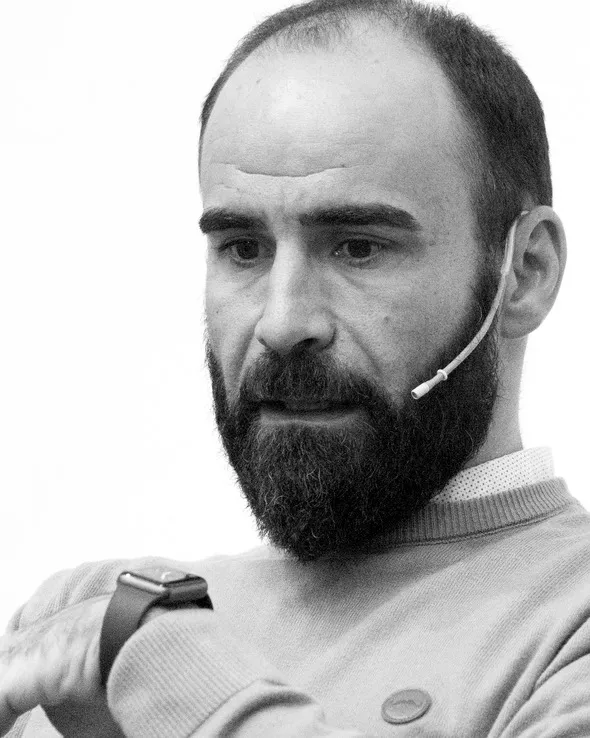
Abel Ramos Callejón is an entrepreneur and science communicator with more than fifteen years of experience managing industrial projects and multidisciplinary teams, including at companies such as Esindus and Duro Felguera.
He founded Xappiens, where he works on digital transformation, systems integration, and applied artificial intelligence for organizations.
Alongside his business work, he teaches, mentors, and writes about technology. In his podcast nosoloIA, he explores artificial intelligence for people who need to understand and use it.
Editions
From the preface